
Industry deep-dive: industry-metal-fabrication
Metal fabrication couples three different pollutants: welding fume that rises straight into the breathing zone, grinding and cutting particulate, and coating overspray. They need different capture physics — which is why one “shop filter” never satisfies an inspector.
How the industry works
- Cutting — laser, plasma, flame or saw cuts produce fine fume and slag dust.
- Welding — MIG/TIG/stick welding releases fume rich in metal oxides that can exceed occupational limits within minutes of arcing.
- Grinding & finishing — abrasive work throws heavier sparks and coarse dust.
- Surface preparation & coating — solvents and paint overspray add VOC and wet aerosol.
- Assembly — the cleanest stage, but only if earlier steps were captured.
Where our equipment fits
| Process stage | Our equipment | What it does |
|---|---|---|
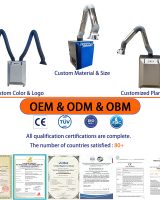
| Welding stations and robots | Welding fume extractor | Captures fume at the torch or through articulated arms before it reaches the welder’s face. |
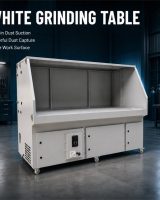
| Bench and pedestal grinding | Downdraft grinding table | Pulls sparks and dust down through the table surface, keeping the work area clear. |
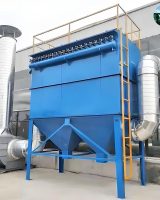
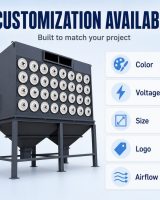
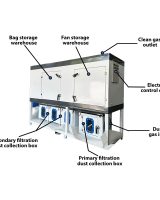
| General machining and CNC | Cartridge dust collector | High-efficiency capture of fine metallic dust with spark-safe inlet options. |
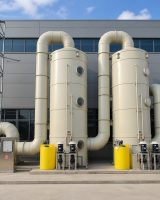
| Paint booths and wet overspray | Wet scrubber | Scrubs sticky, water-soluble paint mist that would blind a dry filter. |
What happens without it
- Welding fume exposes operators above occupational exposure limits within minutes; health monitoring and claims follow.
- Metal dust migrates into CNC cabinets and electrical panels — a well-known cause of short circuits and fires.
- Spark-laden air can ignite aluminium, magnesium or steel grinding dust accumulations.
- Overspray blocks dry filters quickly; without a scrubber on wet lines, filter change frequency becomes a constant cost.
Why our equipment fits this industry
- Source capture (at the torch, the table, the booth) is designed around how fabricators actually work.
- Spark and fire-safety options match insurer and inspector expectations for metal dust.
- Small-to-mid shops get a staged system: arms first, tables next, central units as volumes grow.