

Industry deep-dive: industry-steel-metallurgy
Steel and metallurgy plants make dust from every movement of material: furnace charging, scrap cutting, rolling, grinding and finishing. The dust is heavy, abrasive, sometimes hot, and in some zones fine enough to be a metal-dust explosion risk.
How the industry works
- Raw material handling & charging — scrap, DRI or hot metal moves through bins, feeders and conveyors, releasing dust at every transfer.
- Melting & refining — EAFs and ladle metallurgy generate fume that must be captured at the source before it leaves the shop.
- Rolling & forming — hot rolling throws mill scale and oxide dust; cold rolling and slitting produce fine metal fines.
- Cutting, grinding & finishing — plasma and oxy cutting, weld grinding, shot blasting and polishing create fume and abrasive dust.
- Product handling & dispatch — scale and dust settle on finished coils, plates and profiles, hurting surface quality.
Where our equipment fits
| Process stage | Our equipment | What it does |
|---|---|---|
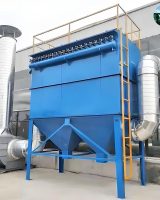
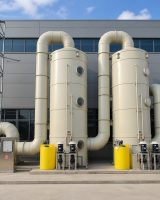
| Furnace charging, ladle and tundish fume | Pulse-jet bag filter or wet scrubber | Captures furnace fume through canopy or direct evacuation hoods before it spreads across the melt shop. |
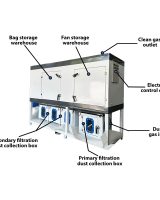
| Rolling, descaling and oxide dust at transfer points | Bag filter with abrasion-resistant hopper options | Handles heavy, gritty loads; hardened outlets and reinforced hoppers survive scale abrasion. |
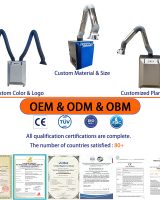
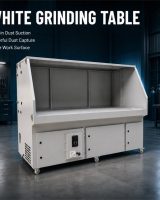
| Plasma/oxy cutting, weld grinding and polishing bays | Downdraft grinding table and welding fume extractor | Keeps fine metal fume away from the welder’s face and out of neighbouring work cells. |
| Fine metallic dust from machining or finishing | Cartridge collector with spark-prevention inlet | Catches respirable metal fines; spark and ember protection options suit grinding and sawing lines. |
What happens without it
- Fine metal dust settles on crane rails, cable trays and roof steel; a single spark turns it into a fire load.
- Mill scale and dust work into bearings, hydraulics and electrical cabinets, cutting machine life between overhauls.
- Furnace fume drifting through the shop blocks visibility for crane operators and triggers local emission complaints.
- Grinding and welding fume puts operators at risk of long-term respiratory claims — the industry’s heaviest safety liability.
Why our equipment fits this industry
- Collectors are sized from your actual line layout and hood requirements, not a catalogue guess.
- Spark protection, abrasion-resistant hoppers and explosion-relief options are built for your risk review.
- Heavy-duty construction and easy access for filter change keep maintenance cost low on two- and three-shift lines.